
Does Window Tinting Really Lower Energy Bills?
Florida homeowners and business owners run air conditioning for most of the year. It is not a seasonal expense. It is a monthly reality. And for many properties in Largo, St. Petersburg, and across Pinellas and Hillsborough Counties, a significant share of that unwanted heat is entering through untreated glass. That raises a fair question: does window tinting actually lower energy bills, or is the savings claim just marketing language? The honest answer is that solar control window film can deliver real, measurable savings for many Florida properties, but what you actually save depends on several factors. Window orientation, your existing glass type, how much direct sun your building receives, and the size of the treated area all play a role. This article walks through how window film works, what the research actually shows, what homeowners and businesses can realistically expect to save, and how to decide whether it is the right investment for your property.
Table of Contents
- How much heat actually enters a home or building through windows
- How window film physically reduces energy use
- What the research and industry data say about window film and energy savings
- Residential energy savings: what homeowners can realistically expect
- Commercial energy savings: what businesses can realistically expect
- Window film versus other energy-saving upgrades
- How long it takes for window film to pay for itself
- FAQ
- Conclusion
How Much Heat Actually Enters a Home or Building Through Windows
Untreated glass is one of the biggest sources of solar heat gain
Standard untreated glass does very little to stop solar energy from entering a space. When sunlight hits a clear pane, a large portion of that solar radiation passes straight through into the room. The Department of Energy has noted that windows are responsible for a significant share of cooling load in many residential and commercial buildings, particularly in warm and sunny climates.
In a state like Florida, where direct sun exposure is intense for much of the year and cooling systems run consistently, this becomes a major financial issue. The more solar energy that enters through windows, the harder your air conditioner has to work to maintain comfortable indoor temperatures. Reducing that solar load at the glass is one of the most direct ways to reduce that cooling demand.
Sun angle and window orientation make the problem worse in Florida
Florida's latitude means solar angles are relatively flat during much of the day, especially in summer. West-facing windows in particular absorb intense afternoon sun directly. South-facing windows receive consistent exposure throughout the day. East-facing windows get the morning sun. Without any solar control, each of these exposures contributes directly to heat buildup inside the building.
For businesses with large glass storefronts or open-plan office floors, the effect is even more pronounced. Employees near windows often feel noticeably warmer, HVAC systems in those zones work harder, and energy consumption spikes during peak afternoon hours. This is why commercial window tinting in Pinellas County has become a practical consideration rather than just a cosmetic upgrade.
Older single-pane glass is especially vulnerable
Many homes and commercial buildings in the Tampa Bay area, particularly older stock, still have single-pane or older double-pane glass that provides very little insulating value. These windows allow heat transfer in both directions, meaning they let solar energy in during summer and let conditioned air escape. For these properties, window film can make one of the most noticeable differences in both comfort and cost.
How Window Film Physically Reduces Energy Use
Solar control film manages the three types of solar energy
Window film does not just darken glass. Quality solar control film is engineered to manage the full solar spectrum: visible light, infrared energy, and ultraviolet radiation. By rejecting a meaningful portion of each, the film reduces the amount of solar energy that enters the building and contributes to heat load.
Different film types manage these energy types in different ways. Reflective films bounce solar energy away from the glass before it enters the room. Ceramic films absorb and re-radiate energy away from the building's interior. Premium film lines such as Vista window film can reject up to 79 percent of solar energy in residential applications, which translates directly to reduced cooling demand.
Less solar load means less strain on HVAC systems
When less solar energy enters a space, the air conditioning system does not have to work as hard to compensate. That reduced load can lower runtime, reduce peak demand charges for commercial properties, and extend the lifespan of HVAC equipment over time. In a climate where AC systems often run for eight to ten months of the year, even modest reductions in runtime accumulate into meaningful annual savings.
This is not a complicated chain of cause and effect. Less heat coming through the glass means lower indoor temperatures, which means shorter or less intense AC cycles, which means lower energy consumption. The key is that the savings are ongoing, not one-time. Once the film is installed, it continues working every day for years.
Film also reduces heat loss in cooler months
While cooling savings are the primary driver in Florida, some film types also help retain interior heat in cooler months by providing a modest additional insulating layer on the glass. For properties in areas like St. Petersburg that do experience cooler winter periods, this can contribute to a slightly more complete year-round energy benefit than many homeowners expect.
What the Research and Industry Data Say About Window Film and Energy Savings
Independent and government research supports window film as an energy-saving tool
The International Window Film Association and multiple independent research organizations have studied the energy performance of solar control window film in real-world building applications. Studies have consistently found that window film can reduce solar heat gain meaningfully, reduce cooling energy consumption in applicable climates, and provide a measurable return on investment when installed on appropriate windows.
The Department of Energy has also recognized solar control window film as an energy efficiency measure and has noted its value for buildings in hot climates where cooling loads dominate annual energy use. Florida fits that profile clearly.
Commercial buildings typically see the most measurable results
Research tends to show the strongest measured energy savings in commercial applications, particularly in buildings with large glass areas, older HVAC systems, and significant south or west-facing glass. Commercial window film installations have been documented to reduce overall building energy consumption by five to fifteen percent depending on factors such as glass coverage, film specification, building type, and climate zone.
For a mid-size office building or retail space in Largo or Clearwater, a five to fifteen percent reduction in energy costs can represent thousands of dollars annually. That scale makes commercial window tinting a financially material decision, not just a comfort upgrade.
Residential data is strong but more variable
For homeowners, savings are real but depend more heavily on individual property factors. A home with multiple west-facing windows, older single-pane glass, and an older HVAC system will see larger measured savings than a recently built home with already-upgraded windows. The key point for home window tinting in St. Petersburg and surrounding areas is that solar heat gain reduction is consistent. Whether it translates to fifty dollars per month or one hundred and fifty dollars depends on the property.
Residential Energy Savings: What Homeowners Can Realistically Expect
Solar heat gain reduction is the primary benefit for homes
For residential properties, the most direct and consistent benefit of window film is the reduction in solar heat gain entering the home through treated glass. Vista residential window film can reject up to 79 percent of solar energy on the treated windows. That means significantly less of the afternoon sun's heat is entering the rooms facing the sun.
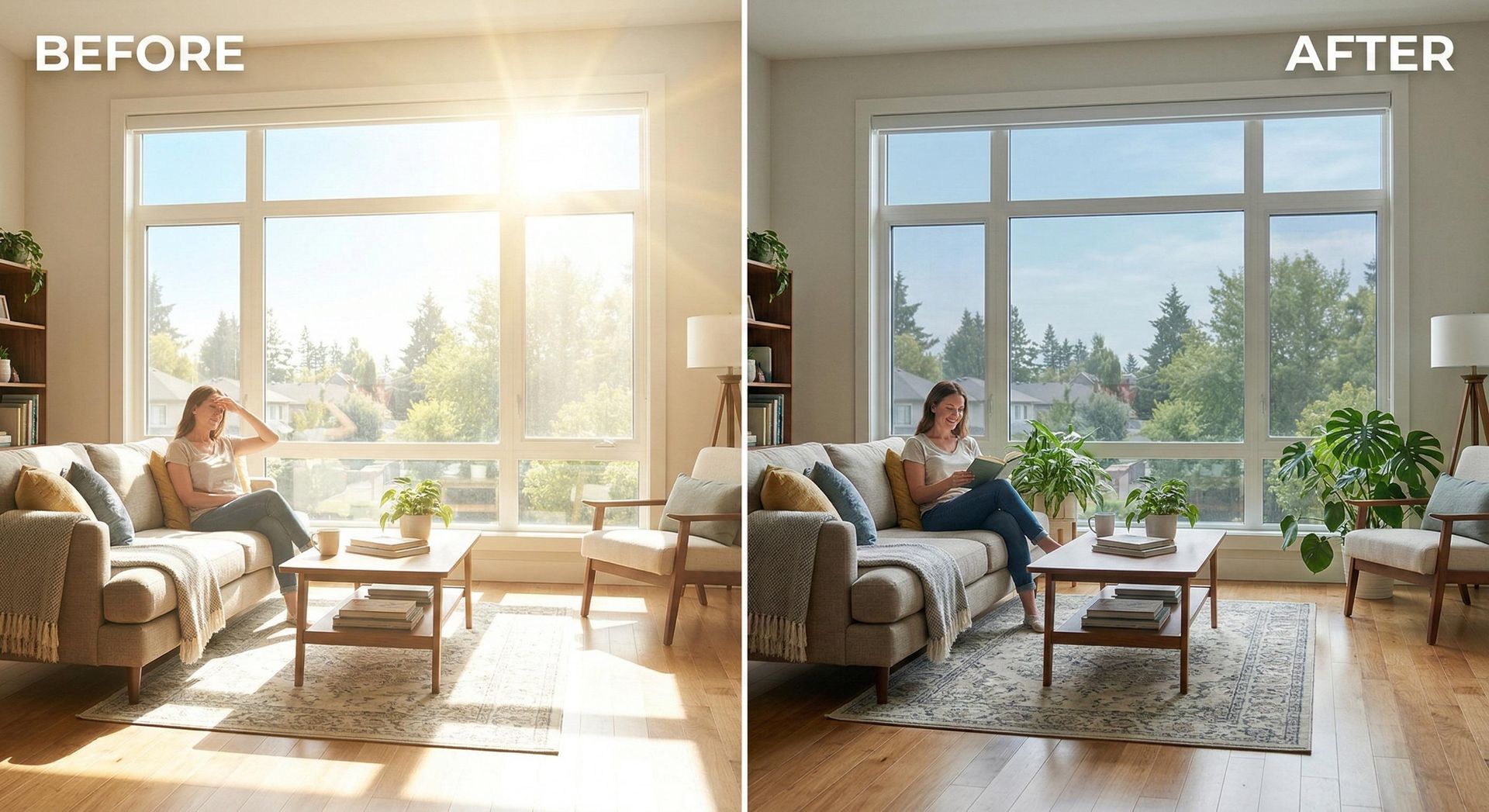
In practical terms, homeowners often notice this first as a comfort improvement. Rooms that previously felt hot or uncomfortable in the afternoon feel more consistently cool. Floors, furniture, and wall surfaces near windows no longer absorb and radiate heat back into the room. The AC cycles less aggressively in those zones, and the overall system runs shorter or less intensely.
Savings vary but the investment case is solid for many Florida homes
Homeowners in Pinellas and Hillsborough Counties commonly see meaningful monthly savings during peak summer months, when cooling costs are highest. Annual savings estimates for qualifying residential projects can range from modest single-digit percentages on a very efficient newer home to higher percentages on older homes with significant glass exposure.
The honest framework is this: the more solar-exposed untreated glass you currently have, the more film can help. A four-bedroom home with west-facing bedrooms and living areas and older windows has more to gain than a small condo with limited glass exposure. The best way to understand your specific savings potential is through a site assessment from a qualified installer.
Additional benefits reinforce the residential value case
Beyond monthly energy savings, residential window film provides UV protection that can meaningfully reduce fading on flooring, furniture, and fabrics. It also improves comfort without changing the appearance of the home from the outside, which matters in neighborhoods with HOA considerations. These benefits reinforce the financial case even when cooling savings alone are not a dramatic number.

Commercial Energy Savings: What Businesses Can Realistically Expect
Commercial properties have the most to gain from window film
For business owners in St. Petersburg, Largo, Clearwater, and across Pinellas and Hillsborough Counties, the energy savings case for commercial window film is among the strongest available in any window-related upgrade category. Buildings with large glass facades, high cooling demands, and older or single-pane glass are particularly strong candidates.
Vista commercial window film, available through High Impact Glass Solutions as a LLumar SelectPro Dealer, can typically deliver five to fifteen percent reductions in energy costs for qualifying commercial buildings, with a payback period of three years or less in many cases. That makes it one of the more compelling energy efficiency investments available without major construction or equipment replacement.
Reduced peak demand charges can be significant
Commercial energy billing often includes peak demand charges based on the highest level of power consumption during a billing period. Solar heat gain through large glass areas during peak afternoon hours contributes directly to these demand spikes. By reducing solar load during peak hours, window film can help lower demand charges in addition to reducing baseline consumption, which can meaningfully improve the overall savings figure for commercial customers.
Employee comfort and productivity are secondary but real benefits
In open office spaces, retail environments, and hospitality settings, solar heat near glass affects employee and customer comfort. Window film can reduce hot spots near windows, lower glare on screens, and improve the overall working environment. While these are not line items on an energy bill, they contribute to the total value calculation for a business owner considering the upgrade.
Window Film Versus Other Energy-Saving Upgrades
Comparing the main options side by side
| Option | Upfront Cost | Typical Energy Savings | Installation Time | UV / Fade Protection | Impact on Natural Light | Security / Safety Benefit | Payback Period |
|---|---|---|---|---|---|---|---|
| Solar Control Window Film | Low to moderate | Meaningful reduction in solar heat gain; commercial buildings often see 5 to 15 percent energy cost reduction | Hours to one day for most projects | Strong UV rejection on quality films | Minimal to moderate depending on film selection | Safety and security film options available | Often 3 years or less for commercial; variable for residential |
| Low-E Replacement Windows | High | Strong long-term improvement, particularly for older single-pane glass | Days; requires construction work | Good on quality units | Minimal if well-specified | Depends on frame and glass specification | Longer; often 10 to 20 years depending on climate and energy costs |
| Blinds and Curtains | Low | Limited; heat is blocked inside the room after it has already entered | Hours | Minimal | Significant reduction in usable natural light | None | May not pay back in energy savings alone |
Residential vs commercial payback comparison
| Application | Typical Upfront Investment | Expected Annual Energy Savings | Typical Payback Period | Key Savings Driver |
|---|---|---|---|---|
| Residential Window Film | Moderate per project | Varies by home size, glass exposure, and existing glass type | Often 3 to 7 years depending on property | Reduced solar heat gain, lower AC runtime |
| Commercial Window Film | Higher total due to larger glass area | Often 5 to 15 percent of total building energy costs | Often 3 years or less for qualifying buildings | Reduced solar load, lower peak demand charges, HVAC relief |
Why window film often wins the value comparison
Window film does not require replacing existing glass, does not disrupt operations for more than a day, and begins working immediately after installation. That combination of low disruption, strong performance, and favorable payback period is why it consistently competes favorably against more expensive alternatives when the goal is energy cost reduction in a hot climate.
How Long It Takes for Window Film to Pay for Itself
Payback period depends on the property and the application
The payback period for window film is calculated by dividing the installation cost by the annual energy savings the film produces. For commercial properties with large glass areas and high cooling loads in Florida, payback periods of three years or less are common. For residential properties, payback periods tend to be longer, typically in the three to seven year range, with ongoing comfort and UV protection benefits continuing well beyond that point.
Window film typically lasts fifteen years or more
Quality professionally installed window film from a recognized manufacturer such as LLumar typically carries a warranty and lasts fifteen years or longer in normal conditions. Even at a conservative five-year payback for a residential installation, that means ten-plus years of net savings for the homeowner after the investment is recovered. For commercial properties with faster payback, the long-term financial case is even more compelling.
Energy prices make the case stronger over time
Florida electricity rates have increased consistently over time and are not expected to reverse. That means the value of every kilowatt-hour saved by window film grows each year. An installation that saves a certain amount annually today will save more in dollar terms five years from now as rates continue to increase. That dynamic strengthens the long-term return on investment case for anyone considering window film in 2026.
The best estimate comes from a site assessment
General payback ranges are useful for context, but the most reliable estimate for your specific property comes from a qualified installer who can evaluate your window orientation, glass type, existing shading, building size, and current energy usage. High Impact Glass Solutions provides free estimates for homeowners and businesses across Pinellas and Hillsborough Counties and can help you understand what Vista window film would deliver for your specific situation.
FAQ
Does window tinting actually lower energy bills?
Yes. Quality solar control window film reduces the amount of solar heat entering through treated glass, which lowers the cooling load on your HVAC system. For Florida homes and commercial buildings, this translates to real, ongoing energy cost reductions.
How much can I save on energy costs with window film?
Savings vary based on property type, window orientation, glass type, and building size. Commercial buildings in qualifying conditions often see five to fifteen percent reductions in energy costs. Residential savings vary more widely by property. A site assessment gives the most accurate picture.
How long does it take for window film to pay for itself?
Commercial applications typically see payback in three years or less. Residential installations often have payback periods in the three to seven year range. Both timeframes are well within the useful life of quality film.
Does window film work as well as replacement windows for energy savings?
Window film often delivers comparable energy savings to low-E replacement windows at a fraction of the upfront cost and without the disruption of window replacement. For many Florida properties, film is the more cost-effective path to solar heat reduction.
Will window film help in winter as well as summer?
The primary benefit in Florida is summer cooling savings, which are significant given the climate. Some film types also provide modest insulating benefit during cooler months, contributing to a more complete year-round value.
Does commercial window film really reduce HVAC load?
Yes. By rejecting a meaningful portion of solar energy before it enters the building, commercial window film directly reduces the heat load that HVAC systems must manage. This can lower both energy consumption and peak demand charges.
How much does professional window tinting cost?
Costs vary by project size, film type, and building complexity. The best way to get an accurate figure for your home or business is through a free on-site estimate from a qualified installer.
Does darker film save more energy than lighter film?
Not necessarily. Film technology matters more than appearance. Some lighter-looking premium ceramic films reject more solar energy than darker basic films. Visible darkness is not a reliable indicator of heat rejection performance.
Can window film be installed on existing glass without replacing windows?
Yes. Window film is applied directly to existing glass surfaces and does not require window replacement. Installation is fast and non-disruptive for both homes and commercial buildings.
Does window film protect furniture and flooring in addition to saving energy?
Yes. Quality window film rejects UV radiation that causes fading and material degradation. This benefit works alongside the energy savings to extend the life of interior furnishings, flooring, and fabrics.
Is window film worth it for a home versus a business?
Both can be strong candidates. Commercial properties generally have faster payback periods due to larger glass areas and higher energy loads. Residential properties benefit from both energy savings and additional comfort and UV protection advantages.
How long does window film last before it needs replacing?
Quality professionally installed film from established manufacturers like LLumar typically lasts fifteen years or longer and is backed by a warranty. Longevity depends on proper installation and normal maintenance.
Does window film add any security or storm protection benefits?
Safety and security film options are available that help hold glass together if it is broken, which can reduce injury risk and improve resistance to forced entry or storm impact. This is a separate film category from solar control film but is available from the same professional installers.
How long does installation take for a home or office?
Most residential and small commercial installations are completed in a single day. Larger commercial projects may take longer depending on the total glass area involved. Film begins working immediately after installation.
How do I know how much I could save with window film for my property?
The most accurate answer comes from a free on-site assessment by a qualified installer who can evaluate your specific windows, orientation, glass type, and current energy use. High Impact Glass Solutions offers free estimates for properties in Largo, St. Petersburg, and across Pinellas and Hillsborough Counties.
Conclusion
Window tinting does lower energy bills, and the evidence is well-supported for both homes and commercial buildings in Florida's year-round cooling climate. Solar control window film reduces the solar heat entering through treated glass, lowers the demand on HVAC systems, and delivers ongoing savings that accumulate over the life of the film. For commercial properties in Pinellas and Hillsborough Counties, Vista commercial window film typically produces five to fifteen percent energy cost reductions with a payback period of three years or less. For homeowners in Largo and St. Petersburg, the combination of lower cooling costs, improved comfort, and strong UV protection creates a compelling value case well beyond the first few years.
High Impact Glass Solutions is a LLumar SelectPro Dealer offering Vista Residential and Commercial Window Films for homeowners and business owners across the Tampa Bay region. If you want to understand how much you could realistically save on your property, contact High Impact Glass Solutions for a free estimate. Their team serves Largo, St. Petersburg, and surrounding areas throughout Pinellas and Hillsborough Counties and can help you choose the right Vista window film for your energy savings goals.